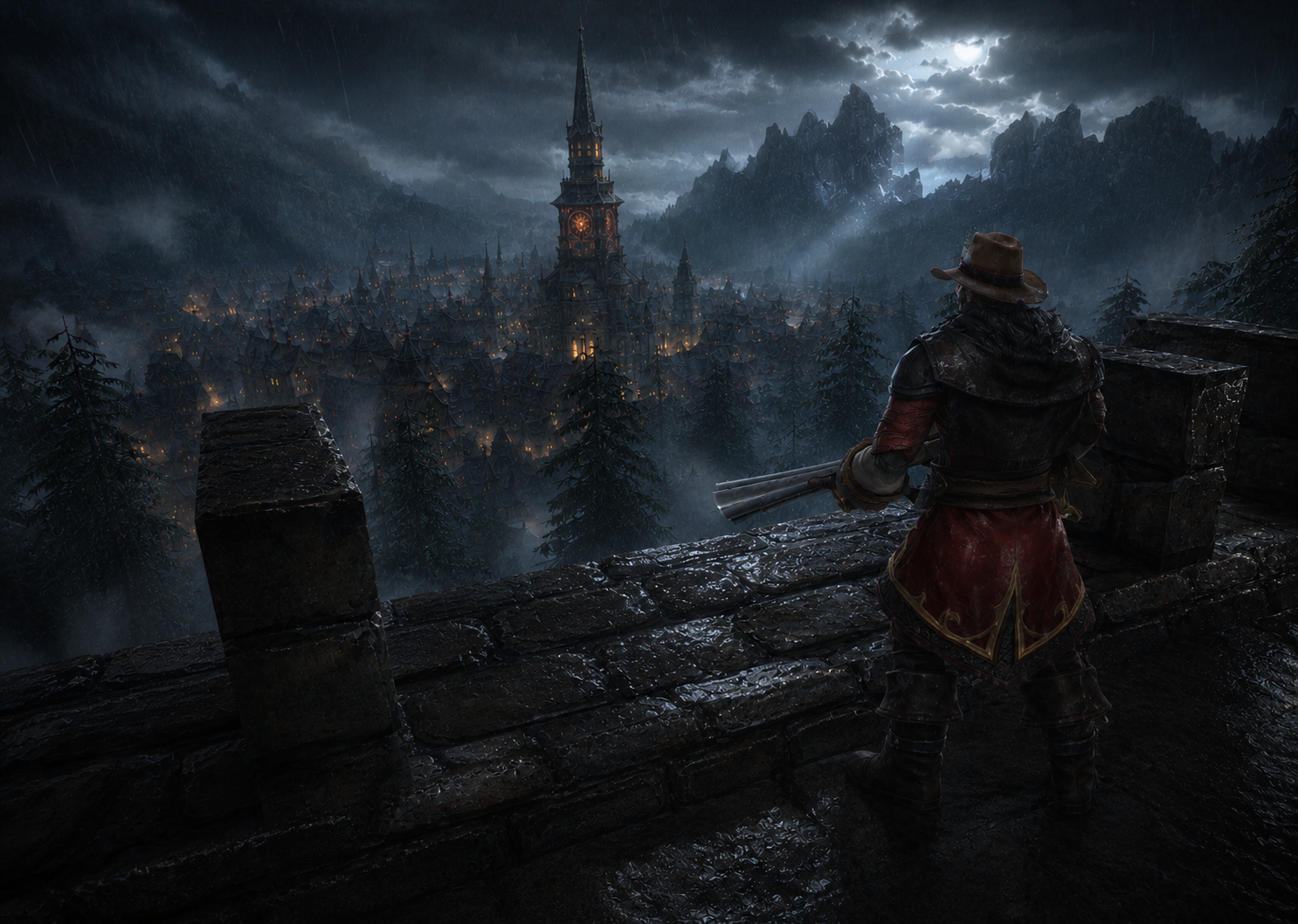
Jarcen "Jarcey" Dreadmoore
Jarcen Dreadmoore, called Jarcey, was the youngest son of a house he never meant to serve.
His brothers grew up closer to the family’s central rot. Morton was the heir, shaped for a title that was never meant to be given. Aidan was the spare, near enough to power to understand its teeth. Jarcey was young enough, distant enough, and neglected enough to learn a different lesson: if House Dreadmoore wanted something from you, the safest answer was distance.
He barely remembered his mother. Morton remembered her clearly, and Aidan carried the broken impressions of a child old enough to know what had been lost. Jarcey had only scraps: warmth, perhaps a voice, perhaps the sense that the house had once contained something gentler than the Baron’s will. When she vanished into the family’s false story of a traveling accident, the last softening influence in his life vanished with her.
So Jarcey left as soon as war gave him the chance.
During the First War, while Gilneas was not the heart of the conflict, he sought any posting that would take him beyond Dreadmoore walls: a Gilnean detachment, a noble escort, a foreign attachment, anything with distance in it. He was young, but Azeroth’s wars were not modern wars of tidy age and paperwork. Boys fought. Jarcey fought.
By the Second War, distance had hardened into craft. Jarcey became a rifleman of powder, patience, and cold habit. He learned to keep his charge dry, his mechanisms clean, his dogs trained, and his sightlines chosen before anyone else knew a fight had begun. He survived his wars less by glory than by preparation.
When the war ended, he left service. He had thought distance from House Dreadmoore was what he wanted. In time, he understood that distance had only been the road. Peace was the thing he had been chasing.
So he returned to the woods of his youth.
Near Pyrewood, among the hunting paths and dark timber he had known before war and family had hardened him, Jarcey built the closest thing to a life he trusted. He hunted, raised dogs, trapped, traded for supplies, and kept people away. He shaped that life with his own hands: rifles, ammunition, explosives, traps, tools, and eventually stranger machines besides. In later years he built a motorcycle, then a gyrocopter from plans bought off a gnomish merchant. He trusted springs, gears, powder, dogs, and terrain because they did what they were made to do and rarely lied about it.
He did not find love in Pyrewood. He had known women abroad, but war had a way of making affection dangerous. Some died. Some tried to kill him. Solitude proved more reliable, and Jarcey was a practical man.
The worgen came slowly at first.
In the beginning, they were not a siege. They were an incident every few moons: a shape at the edge of the trees, torn livestock, a missing traveler, something from Arugal’s tower that had slipped too far and met Jarcey before it met the town. He did not call himself Pyrewood’s guardian. He hunted, survived, and kept monsters away from his own ground. Because he was very good, the danger looked smaller than it was.
The years made the pattern worse. Tracks multiplied. Attacks came closer together. The woods changed in ways only someone like Jarcey could read early. He warned the Pyrewood militia, but warnings from a Dreadmoore recluse carried only so much weight. By the time they believed him, belief no longer mattered. They wanted him to join them, to train them, to help make a stand. Jarcey refused. He knew the difference between defense and burial.
Pyrewood fell to the curse. Jarcey remained one of the few living, uncursed humans left in the woods outside the Greymane Wall, a stubborn human shape in country that had become wolf-haunted and half-lost.
Then the Forsaken came.
Jarcey resisted them as he had resisted everything else that entered his woods without permission. Scouts disappeared. Patrols found traps underfoot and rifle fire from impossible angles. Roads failed. Supplies burned. Men died without seeing him. He was astonishingly effective, but still only one man, and one man cannot stop an army forever.
When the Greymane Wall was breached and Darius Crowley’s Gilneas Liberation Front retook Pyrewood, Jarcey joined them. It was the first cause in many years that suited him: not a court, not a noble house, not a polished army, but a hard insurgency with blood in its teeth and no patience for ceremony. He fought beside Crowley and the Bloodfang Pack for the rest of that campaign.
He remained human among them. Around him were claws, fur, rage, and men who had chosen the curse as a weapon. Jarcey stayed what he had always been: uncursed, armed, stubborn, and unwilling to be remade. The sole man among wolves.
Afterward, his first loyalty remained narrow: Gilneas, Crowley’s fight, the lost woods, and the few people who had earned more than suspicion. Yet war kept finding him. He was present at the Siege of Orgrimmar, where his rifle, traps, and explosives found grim use against another fortified enemy.
During the Third Invasion of the Burning Legion, Jarcey fought again and joined the Unseen Path, the order of hunters who gathered to defend Azeroth from the Legion’s beasts and horrors. Among them he served as he always had: rifleman, engineer, trapper, survivor, and one of the most dangerous ordinary men ever to walk into a monster’s territory and come back out.
After the Legion’s defeat, Jarcey joined Morrivar Company, an Alliance-aligned military company built around veteran champions and specialists. He did not join because he had made peace with old houses. He had not. He joined because some people had proved worth standing beside, and because the world still had things in it that needed to be tracked, trapped, shot, burned, or buried before they reached someone else’s door.