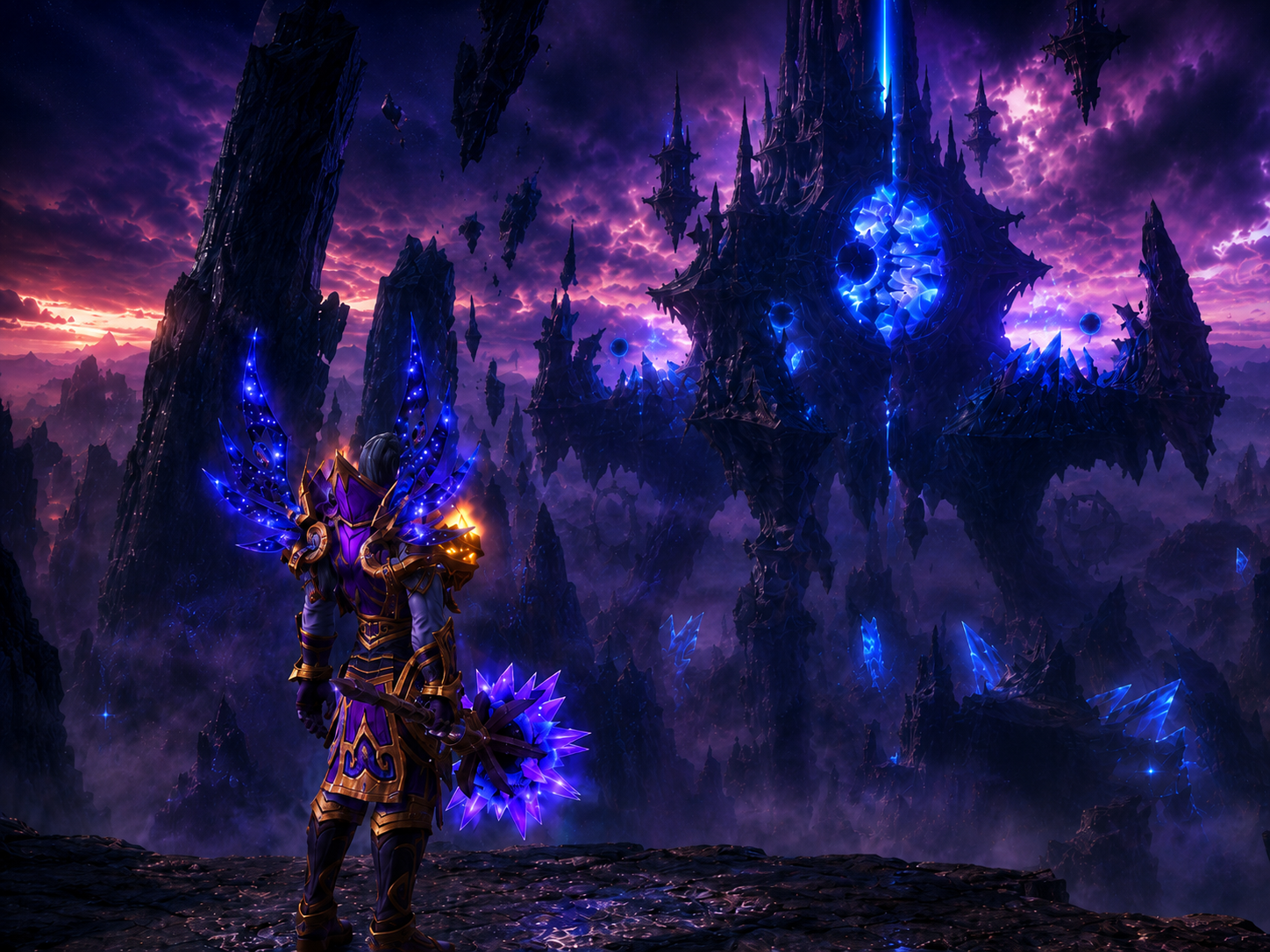
Caldrys Dusksinger, the Darkener
Caldrys was already old when most men first learned to fear the name of Silvermoon.
He belonged to the long memory of Quel’Thalas, to the generation that had watched kingdoms rise and rot beyond elven borders while the forests of home endured. Age did not soften him. It refined him. By the time the Blood Knights rose from the ruin of the Sunwell, Caldrys Dawnsinger had already become a man of hard convictions, and the order gave those convictions armor, ceremony, and a weapon bright enough to call holy.
He was not gentle in the Light.
In the earliest days of the Blood Knights, Caldrys accepted power as many of his people did: with hunger, pride, and the certainty that survival excused much. The restoration of the Sunwell changed him, as it changed the order. What had begun in force became discipline. What had been seized became service. The Light became judgment, burden, and proof that the sin’dorei could endure without crawling back into the hungers that had nearly destroyed them.
That was why he hated the Void.
To Caldrys, the Void was not mystery. It was appetite with a scholar’s mask. He had seen what addiction, desperation, and forbidden power had done to his people once already, and he had no patience for elves who called the next abyss enlightenment. He hunted void-cults, burned out hidden rites, and persecuted sin’dorei who studied powers he believed should have remained buried. If he was severe, he considered severity a virtue. Mercy toward corruption was only another word for surrender.
During the Third Invasion of the Burning Legion, Caldrys served in the reformed Silver Hand under Highlord Cairden Morrivar, fighting beside paladins of many peoples in a war larger than faction. He emerged with his convictions sharpened. The world had survived because some powers were resisted, not studied.
Then came the void elves.
After Alleria Windrunner’s return and the exile of those who had delved too deeply into the Void, the boundaries Caldrys trusted began to fray. When some of the newly changed kept old contacts in Silvermoon, he pursued a band of them through a Void portal, expecting treason, corruption, and the usual arrogance of elves who believed they could stand at the edge of oblivion and remain untouched.
He found Telogrus Rift in battle.
The void elves there were not triumphant scholars presiding over secrets. They were fighting for survival against a nameless horror that had come ravening through the dark. Caldrys did not pause to weigh whether they deserved aid. Whatever they had done, the thing before him was worse. He was still a paladin. He raised his weapon and entered the fight.
The horror took him.
It dragged him into the deeper ruin of the rift, where light thinned, direction failed, and whispers gathered like flies around an open wound. It wanted him alive. A paladin’s will, a Blood Knight’s discipline, a hunter’s hatred of the Void: all of it would make a finer servant if bent rather than broken. It poured itself into him and tried to turn his own certainty into a chain.
For a time, it succeeded.
Caldrys felt the Void answer where the Light had once answered cleanly. He heard thoughts that were not his own speaking in the shapes of his doubts. He saw his old judgments turned inward: every elf he had condemned, every cruelty he had excused as duty, every moment when zeal had been easier than wisdom. The horror wanted a knight of the Void, armored in the remains of a paladin.
It misjudged him.
Caldrys did not master the Void in any way he would have once respected. He survived it. He seized the corruption forced into him with disgust, shaped it through the habits of oath and judgment, and drove it back against the thing that had claimed him. The horror had no name worth preserving. It died in the rift, slain by the servant it had failed to make.
What escaped was Caldrys, but not as he had been.
For a time, he still called himself Dawnsinger. Dawnsinger had been more than lineage. It had meant dawn after ruin, Light after hunger, Quel’Thalas enduring beneath the restored Sunwell. To surrender it felt too much like yielding the last clean thing the horror had failed to take.
But Silvermoon never opened its gates to him.
Word reached the city before he did: a Blood Knight missing in Telogrus, a hunter of the Void returned wearing its mark, a paladin whose radiance had gone cold and starless. Whether by decree, fear, or the quiet agreement of those who once would have called him brother, Caldrys was refused the homeland he had bled to defend. He was not tried. He was not absolved. He was simply made impossible.
That was when the name became unbearable. House Dawnsinger had survived war, addiction, ruin, and restoration. Caldrys would not make it a warning whispered beside the Void. If Silvermoon would remember him as a corruption, then he would not let that corruption wear the dawn.
So he laid the dawn down.
He chose Dusksinger not as an embrace of shadow, but as a sentence upon himself. Dusk was not night. It was the last contested hour, where light failed but had not yet surrendered. Let House Dawnsinger remain what it had been. Let Caldrys Dusksinger carry what came after.
The other name came from Telogrus. Survivors spoke of how the rift dimmed when he slew the horror, how its own darkness was seized, judged, and driven back into its heart. Caldrys had not shone against it. He had darkened it.
Among the void elves, the name passed in wary whispers. Among the sin’dorei, it curdled into condemnation. Among Alliance soldiers, it became a battlefield summons.
The Darkener.
Caldrys never liked it. That was why he allowed it to remain.
Among the void elves, he found no easy kinship. They spoke of balance, possibility, and discipline. Caldrys heard temptation dressed in calmer language. He had not come to the Void by curiosity or ambition. It had been inflicted upon him, and he trusted least of all those who had walked toward it willingly.
The Alliance suited him better than he cared to admit. Beneath his loyalty to Silvermoon, Caldrys had long preferred its order to the Horde’s brutal pragmatism. Among the Alliance, he was still feared, but he could be useful without pretending that the Void was a gift.
Caldrys did not cease being a paladin when the Void took him. He kept the oaths, the armor, the discipline, the habit of judgment. Only the radiance changed. Where the Light had once shone, there now gathered a starless pressure, cold and terrible, bent by will into the shape of retribution.
The Void had taken his certainty, his place among his people, the clean simplicity of his old faith, and even the dawn of his name.
It had not taken his judgment.