
Korguk

Character Sheet
Appearance
- Gender: Male
- Apparent Age: Older adult
- Height: Tall
- Build: Stocky
- Hair: Gray
- Eyes: Violet
- Skin: Gray
- Facial Hair: Beard
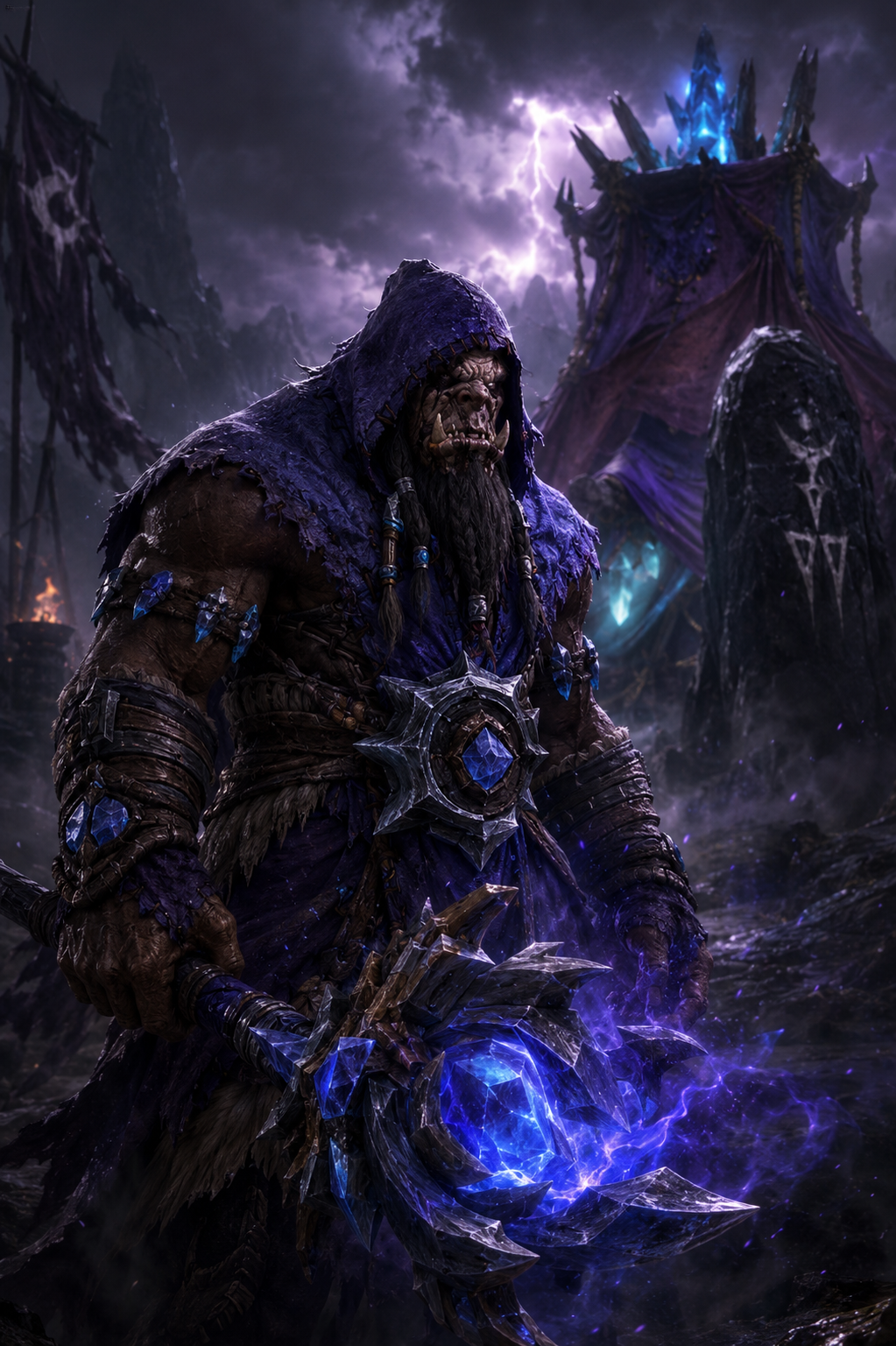
Overview
Korguk is an elder Shadowmoon orc priest from the alternate Draenor timeline and is affiliated with the Horde. His identity is rooted in the spiritual inheritance of the Shadowmoon clan rather than in a generic modern conception of a Void-focused priest. He fought first for the survival of his clan within the Iron Horde, later endured the Lightbound war with the surviving Mag’har, and reached Azeroth as a formidable old guardian of Shadowmoon religious identity.
Shadowmoon Heritage
Korguk’s priestly tradition predates Ner’zhul’s later use of the Dark Star. His Shadowmoon practice encompasses shadow, death, ancestors, prophecy, omens, and celestial or stellar concerns. Void-derived techniques later become part of that practice through the Dark Star period, but they do not retroactively define its whole character. Korguk remains a Shadowmoon priest first.
Korguk was approximately fifty-five years old during the War Against the Iron Horde. He was already an established elder of the Shadowmoon clan, with substantial priestly experience and memory of older practices, while remaining capable of active wartime service. Decades later, when he reaches Azeroth with the rescued Mag’har, he is perhaps approximately eighty-five. His continued effectiveness is striking but unexplained: he remains mentally sharp and dangerous without presenting as a man whose age has been magically erased.
The Iron Horde
The Shadowmoon were not enthusiastic founding partners of the Iron Horde. Ner’zhul entered the coalition under coercion and under a threat to the clan’s survival, and Korguk followed Ner’zhul and the Shadowmoon for the same reason. His loyalty lay first with the clan, not with the Iron Horde as an ideological project. He accepted participation because the alternative promised destruction or catastrophic loss for his people.
Korguk understood that Ner’zhul’s later Dark Star practices violated serious ancient Shadowmoon prohibitions. He did not mistake them for ordinary or orthodox religion, nor did he conclude that the older boundaries had been meaningless. In the existential pressure of war, however, he accepted that forbidden practices could be temporarily necessary to secure the clan’s survival. His objection was defensive and conservative: emergency measures could not be allowed to become the ordinary Shadowmoon way.
He did not defect from the clan, materially resist Ner’zhul’s leadership, or join the Shadowmoon Exiles during the war. His disagreements concerned boundaries, tradition, and the danger of normalizing what should remain forbidden. The exact nature of his relationship with Ner’zhul, including any personal closeness or formal advisory role, remains unknown.
Defeat and Reflection
Korguk remained with the Shadowmoon through the Iron Horde’s defeat. He did not undergo a dramatic ideological conversion; he had never treated the coalition’s survival as an end in itself. Once it had lost, prolonging a failed war for the sake of the Iron Horde alone offered little to a priest whose priority had always been preserving his clan. The surviving Shadowmoon were eventually incorporated into the broader Mag’har Clans, but their clan identity remained meaningful within that larger polity.
The decades between the Iron Horde’s fall and the Lightbound crisis gave Korguk time to reconsider what wartime flexibility had cost. He did not simply decide that his earlier reasoning had been false. He still understood the genuine existential pressure under which the Shadowmoon had acted and the possibility that survival can require actions otherwise forbidden. What changed was his understanding of the aftermath. The Dark Star’s wartime use, the erosion of older boundaries, the destruction of Ner’zhul’s order, and the Iron Horde’s eventual collapse taught him that emergency transgression leaves lasting marks. A people can survive physically while losing the inheritance that gives their survival meaning.
The Lightbound War
The rise of the Lightbound made that lesson decisive. Their threat was not merely military or political, but the pressure of a rival religious order seeking to remake Draenor and absorb, convert, or destroy those who resisted. For Korguk, the danger now included the possible loss of Shadowmoon religious identity itself.
During this conflict, he became markedly more dogmatic and uncompromising in defense of Shadowmoon tradition. That rigidity was earned through earlier flexibility, the failure and cost of those compromises, and long reflection on what the clan had nearly lost. Among the surviving Shadowmoon within the Mag’har Clans, he became a significant religious figure through age, priestly knowledge, magical effectiveness, conviction, and continuity. He provided resistance, morale, doctrinal firmness, and a living connection to the Shadowmoon inheritance. His influence may be respected more broadly among the Mag’har, but he is not established as their overall political or religious leader.
Korguk’s magic remained recognizably Shadowmoon throughout these years: shadow, death-oriented and ancestral practice, prophecy and omens, celestial symbolism, and later Void-derived techniques associated with the Dark Star period. This combination made him an especially effective spiritual and magical opponent of the Lightbound without reducing him to a conventional Void spellcaster. The specific spells, rituals, artifacts, and powers he uses remain unsettled.
Arrival on Azeroth
Korguk remained on alternate Draenor through the postwar decades and the Lightbound conflict. He was eventually among the Mag’har brought to Azeroth during their later rescue and recruitment. His acceptance of the Azerothian Horde required no dramatic conversion: he had never been devoted to the Iron Horde as an end in itself, and the Horde offered the surviving Draenor clans a viable wider orcish society in which they could retain their own identities.
He entered Azeroth as an elderly Shadowmoon survivor, a veteran of the Iron Horde period and Lightbound war, and a far more determined guardian of Shadowmoon religious tradition than he had been decades earlier. His first interactions, personal sponsors, immediate duties, and later relationships in the Horde remain open.
Relationships
Affiliations
- Horde - current
- Shadowmoon clan - religious and cultural inheritance
Timeline
- Was an established Shadowmoon elder by the War Against the Iron Horde.
- Remained with the Shadowmoon inside the Iron Horde during the conflict, accepting Dark Star practices as a wartime necessity without treating them as orthodox tradition.
- Survived the Iron Horde’s defeat and remained within the Shadowmoon element later incorporated into the Mag’har Clans.
- Spent the following decades reconsidering the cost of wartime religious compromise.
- Became a significant defender of Shadowmoon identity during the Lightbound war.
- Reached Azeroth with the rescued Mag’har and entered the Horde.
Hooks
- Define Korguk’s personal relationship with Ner’zhul and the exact limits of his disagreement over the Dark Star.
- Establish Korguk’s first interactions, duties, and relationships after arriving in the Azerothian Horde.
- Define his specific priestly magic without reducing his Shadowmoon tradition to Void spellcasting.