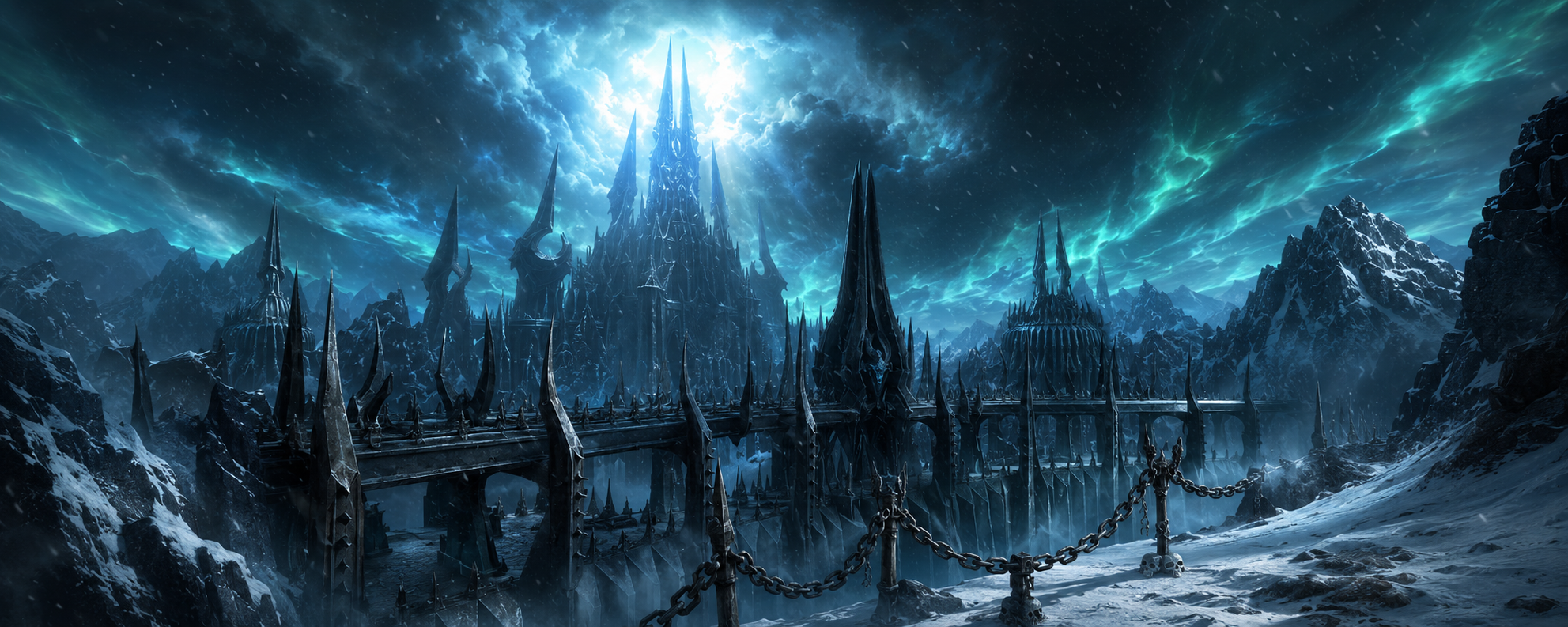
Skullcrush
Character Sheet
Identity
- Full Name: Gorak Skullcrush
- Known As: Skullcrush
Vitals
- Condition: Undead
- Undead Type: Darkfallen
- Darkfallen Type: Death Knight
Appearance
- Gender: Male
- Apparent Age: Adult
- Height: Tall
- Build: Massive
- Eyes: Blue
- Skin: Green
- Facial Hair: None
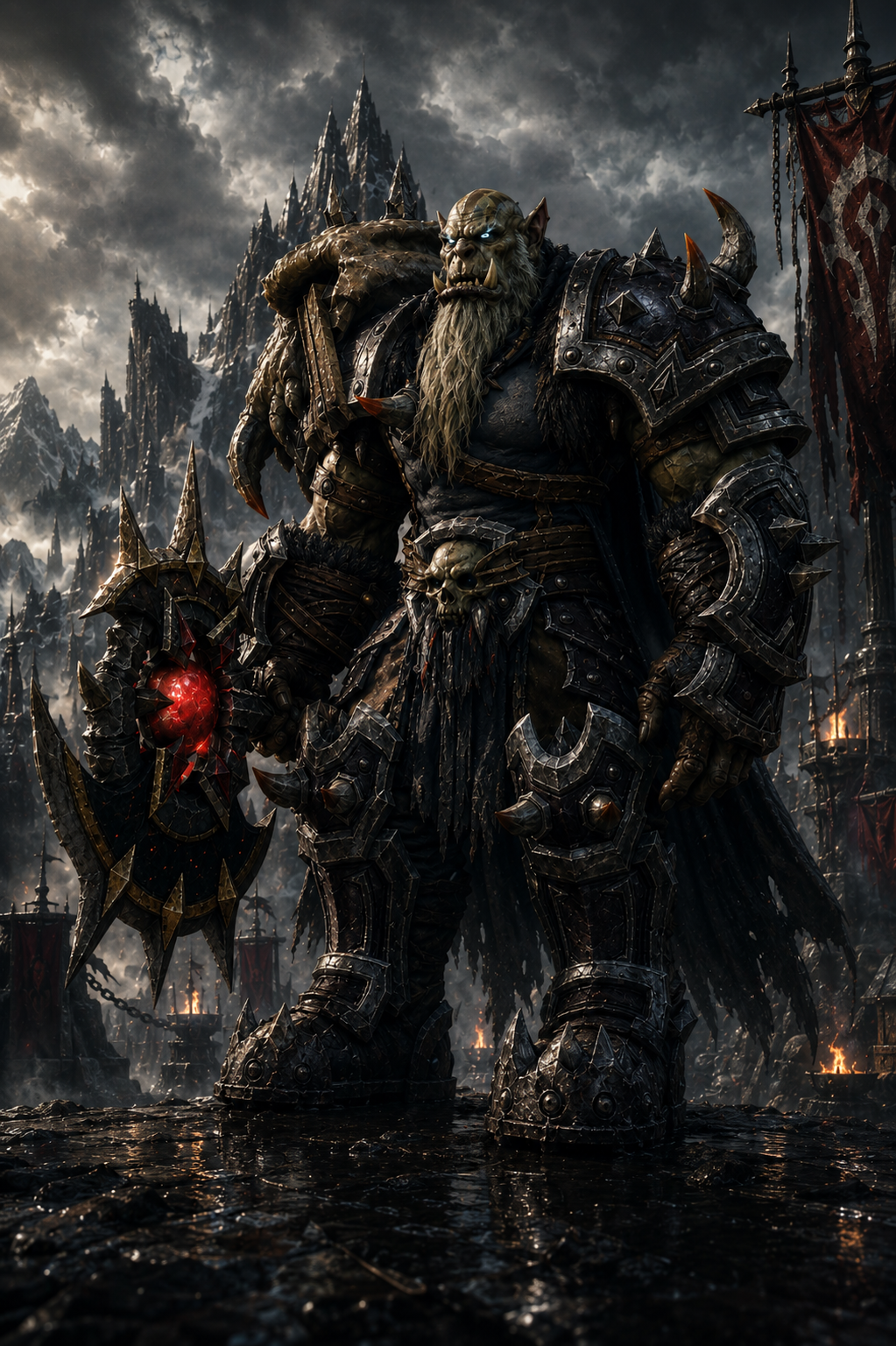
Overview
Gorak Skullcrush is an undead orc of Durotar and a death knight of the Horde. Skullcrush is the battlefield name he carried out of mortal warfare and into undeath, not a known birth-family surname. Once a promising Horde warrior and a minor war hero, he was killed in the Northrend war, raised into Arthas’s Scourge, and made to fight against the people he had once served. His eventual return to the Horde begins not with hope of absolution, but with a warning he believes cannot be left unspoken.
Durotar and the Horde
Gorak grew up in Durotar among the post-Third-War orc population of Thrall’s New Horde. He came of age during the vanilla-era period, passing through the Valley of Trials as a young orc entering recognized adulthood and military life. Agoro was already an experienced soldier assigned there at the time. Gorak knew him as one of the established warriors in the Valley, while Agoro retained only the ordinary memory of one among many young orcs who passed through it. No special bond, mentorship, or close friendship began there.
Afterward, Gorak entered Horde military service. Over the following years he became a capable and respected young warrior, earning the battlefield name Skullcrush during his mortal life. The circumstances in which he earned it remain unrecorded. By the war against the Lich King, he had enough service and battlefield distinction to be regarded as a genuine Horde war hero, though not as one of the era’s great public champions. He and Agoro may have fought in the same broader operations on one or two occasions, but they were not regular comrades, members of the same unit, or close partners.
The Name Skullcrush
The name marks Gorak’s martial reputation without settling the circumstances in which he earned it. It was a name of mortal service before it became the name by which Horde veterans later remembered an undead enemy.
Death and Scourge Service
Gorak was killed during the war against the Lich King and raised by Arthas into a later generation of Scourge death knights. He was not one of the original Acherus death knights who rebelled at Light’s Hope Chapel. Enslaved to Arthas, he served the Scourge as a death knight and fought against the Horde, killing members of the people he had once served.
Agoro saw enough of Skullcrush in Arthas’s forces during the Northrend war to recognize the reality of what had happened. He could confirm that Gorak was dead, that the death knight was genuinely the same orc, and that Skullcrush was actively fighting against the Horde. They did not establish a personal duel in Northrend.
Lost Years
Gorak survived Arthas’s fall and at some later point regained his autonomy. The cause remains unknown, and Gorak himself may not fully understand why the compulsion ended. He did not immediately return to the Horde or seek out the Knights of the Ebon Blade. Instead, he spent years in near-total isolation at the edges of society and in forgotten wilderness, caves, ruins, and abandoned places.
As an undead death knight, Gorak did not depend on ordinary living needs such as food, sleep, or shelter. This made possible an early period of bare persistence in which he could remain in one place for months or years with almost no outward activity. It was not a failure of intelligence or thought, but a condition of having recovered autonomy without recovering purpose, identity, belonging, or direction.
That inward awakening came slowly. Gorak gradually began to reckon with his mortal service, what Arthas had made him, the killings committed while enslaved, and the distinction between actions performed through his body and actions chosen by his own will. By the later part of his isolation, he regarded himself as lost, condemned, irredeemable, or otherwise beyond restoration. That bleak judgment did not remove his sense of obligation. He could believe himself beyond redemption while still believing that he remained responsible for acting correctly where he could.
Return to Orgrimmar
Before or during the lead-up to the Third Invasion, Gorak encountered a threat serious enough that he concluded the Horde had to be warned. Its nature, location, timing, and the means by which he discovered it remain unresolved. By then he had become reflective enough to investigate what he had found, understand its significance, and recognize that someone needed to know. The Horde was where the warning belonged, even if he could not yet comfortably think of it as his people.
He returned to Orgrimmar with physical evidence of the threat. Cloaked, he was initially able to move through the city without attracting much notice. Scrutiny increased as he approached Grommash Hold, where he was stopped and identified as Skullcrush. The recognition produced immediate alarm among veterans who remembered both the former Horde warrior and the Scourge death knight who had fought against them. Gorak was nearly detained, but insisted on reaching the Warchief or other command authority appropriate to the moment. The identity of that authority remains dependent on the final chronology of his return.
Once before Horde leadership, Gorak did not begin by defending or explaining himself. He presented the physical evidence first. It was concerning enough to be taken seriously on its own and to bring together an appropriate group to hear more. Gorak then provided a detailed, useful briefing: he could explain what he had observed, answer operational questions, distinguish fact from uncertainty, and state what action he believed necessary. His old military competence had substantially returned, even if his manner remained restrained and guarded. When discussion of his Scourge past threatened to eclipse the immediate danger, he refused to let it take priority over the threat at hand.
Agoro may recognize Gorak during or shortly after his arrival, but does not automatically accompany him into the initial briefing. Officials later consult Agoro because his limited familiarity spans several stages of Gorak’s life. He can credibly attest that Gorak was once an honorable Horde warrior, that the death knight who later fought for Arthas was genuinely the same orc, and that neither truth cancels the other. His assessment is neither a defense nor an absolution.
Return to Service
Gorak’s intelligence proves accurate and materially useful, prompting action by the Horde and drawing him personally into the threat’s resolution. The precise enemy, operation, and outcome remain unresolved. His involvement nevertheless demonstrates that he can again act as a competent warrior by his own will and marks his meaningful return to active history.
The episode does not leave him healed or fully reintegrated. Returning to Horde society forces Gorak to confront accusations and questions he had previously considered mostly in isolation. He rejects the claim that he willingly betrayed the Horde, yet cannot dismiss the fact that his own body, memories, and awareness were present when he killed Horde soldiers under Arthas’s compulsion. The unresolved tension between not choosing those actions and having done them remains central to his developing identity.
After the warning has been vindicated, Gorak is eventually connected with Horde death knights already serving in the Knights of the Ebon Blade. That connection becomes his path to Acherus and voluntary membership in the order. He is neither an original Acherus rebel nor one of the death knights later raised deliberately by Bolvar. He is an Arthas-raised Scourge death knight who joins the Ebon Blade only after years of independent existence following Arthas’s defeat. The order is one of the first major institutions he enters by choice after his death.
Third Invasion
Gorak becomes meaningfully involved with Acherus and the Ebon Blade in the lead-up to or during the Third Invasion. As Acherus serves as a major staging center and the order takes a central role in Azeroth’s defense against the Burning Legion, he finds a clear institutional place for what he has become. His exact Legion missions, rank, relationships with other death knights, and role within the order remain unsettled.
Relationships
- Agoro - a credible but limited witness to Gorak’s youth in Durotar, mortal Horde service, and later Scourge service
Affiliations
- Horde - current
- Knights of the Ebon Blade - later voluntary affiliation
Timeline
- Grew up in Durotar and entered recognized adulthood and military life through the Valley of Trials.
- Entered Horde military service, earned the name Skullcrush, and became a respected young warrior.
- Was killed during the war against the Lich King and raised by Arthas into a later generation of Scourge death knights.
- Fought against the Horde while enslaved to Arthas.
- Regained autonomy at an unresolved point after Arthas’s defeat and spent years in isolation.
- Returned to Orgrimmar with a warning and physical evidence of an unresolved threat before or during the lead-up to the Third Invasion.
- Helped resolve the threat after his warning proved accurate and materially useful.
- Later entered Acherus and joined the Knights of the Ebon Blade by his own choice.
- Took part in the Ebon Blade’s defense of Azeroth during the Third Invasion.
Hooks
- Define the circumstances in which Gorak earned the name Skullcrush and the details of his mortal military career.
- Determine how Gorak regained autonomy after Arthas’s defeat.
- Define the threat, physical evidence, timing, and command authority involved in his return to Orgrimmar.
- Establish the exact operation through which Gorak’s warning is vindicated.
- Define Gorak’s later Ebon Blade service, rank, and relationships without resolving his reckoning with Scourge violence prematurely.
Notes
- Gorak stands in for Gorgrim Shadowcleave during the Argent Tournament.