Garni
Character Sheet
Identity
- Full Name: Garni Blackforge
- Family Name: Blackforge
Vitals
- Condition: Undead
- Undead Type: Darkfallen
- Darkfallen Type: Death Knight
Appearance
- Gender: Male
- Apparent Age: Adult
- Height: Short
- Build: Broad
- Eyes: Blue
- Skin: Dark gray
Overview
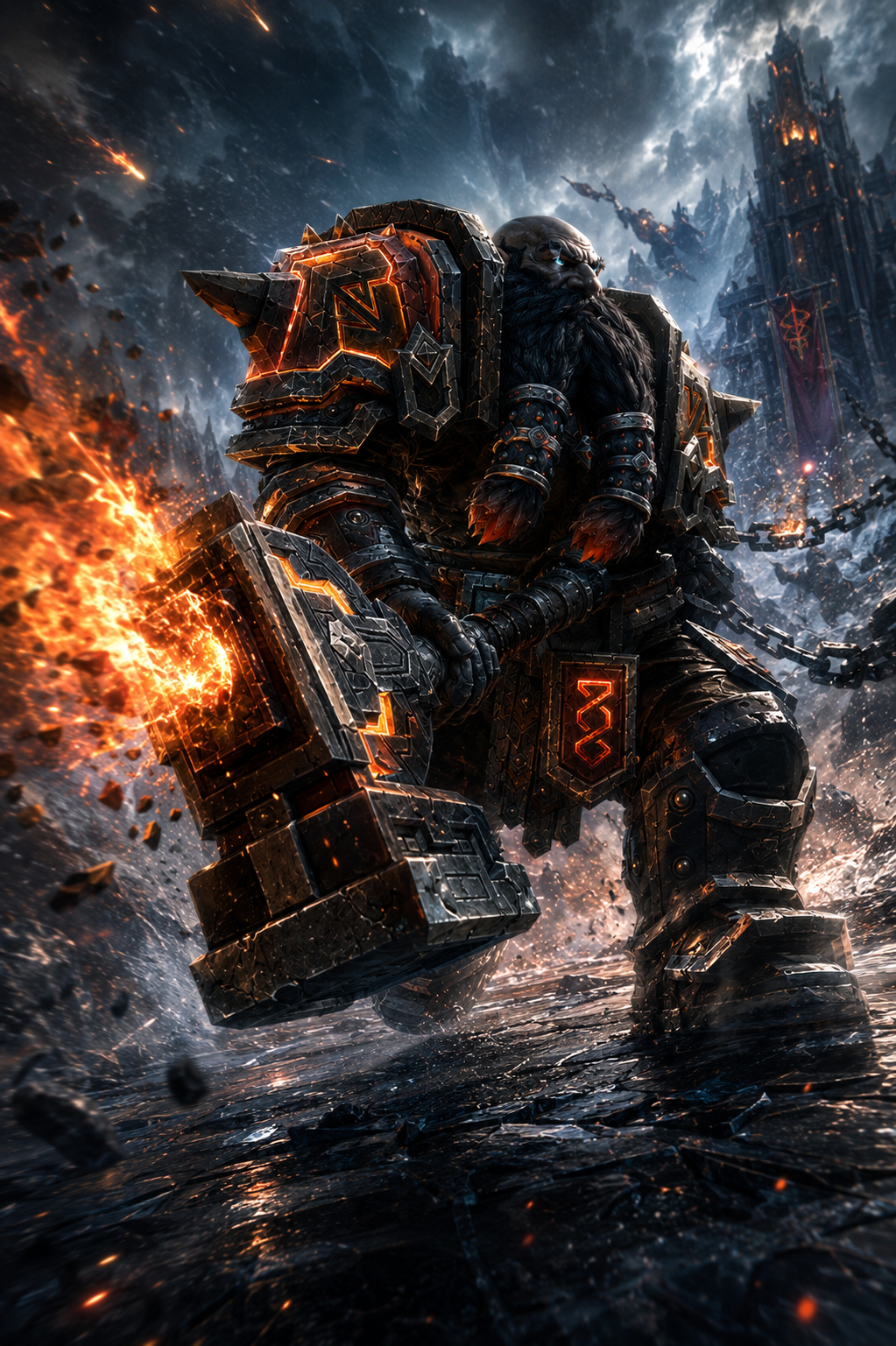
Garni Blackforge is a Dark Iron dwarf death knight. In life, he was a prominent and favored son of Clan Blackforge, though never its heir, and an exceptionally proud Dark Iron warrior and officer. He was revered throughout Shadowforge as one of the community’s foremost defenders while eagerly fighting the Bronzebeards and Wildhammers during the old conflict. His later return from death preserves, rather than erases, his Dark Iron pride, military identity, hostility toward the other clans, and personal history with the dwarves he once fought.
Clan Blackforge
Garni’s standing rested on personal reputation rather than succession. Clan Blackforge was associated with the founding and establishment of the Black Forge complex, and Garni was counted among the wider Shadowforge community’s significant defenders. His battlefield reputation did not temper his chauvinism. He believed strongly in Dark Iron superiority, had little regard for Bronzebeards or Wildhammers, and expressed that contempt through boasting, sneering, and direct insults.
During the old war, Garni fought Aibhinger multiple times. One encounter became a prolonged personal duel between Garni’s fiery greathammer and Aibh’s mechanical fists. He also encountered Orenne during the conflict. These were not anonymous enemies to him: Garni remembered both dwarves clearly after the war.
Garni survived the old conflict and lived through the reunification of the dwarven clans. He accepted the settlement but deeply resented it, seeing submission where others saw reconciliation. He considered Moira weak for failing to assert stronger Dark Iron dominion over the other clans. Even so, he did not become a rebel. He remained an effective officer who obeyed legitimate orders and could cooperate tactically with other dwarves when commanded. His hostility was political and temperamental rather than operational.
After reunification, Garni was permitted to operate within Ironforge despite Aibh’s specific objection. Garni knew that Aibh had argued against admitting him and took lasting satisfaction in the fact that Aibh lost. He did not apologize for his wartime conduct, and the political arrangement remained humiliating and bemusing to him rather than genuinely amusing. Had he lived longer, he might have become a rallying figure for harder-line Dark Iron resistance to Moira’s settlement, but he died before that possibility was resolved.
Garni died during the Legion era. The loss was politically complicated: the clans lost an exceptional warrior and officer, while the Dark Iron people also lost a potential future source of internal unrest. He died before openly rebelling against Moira or the reunified order.
Fireblood in Life
Even while living, Garni had learned to intensify his inherited Dark Iron Fireblood into a dangerous personal combat enhancement. He deliberately infused his own blood with elemental fire, driving heat and flame through his body to increase his strength, striking power, speed, aggression, endurance under punishment, and destructive intensity.
The state was painful. Garni embraced that cost as proof that he was strong enough to force himself beyond ordinary limits and as evidence, in his own mind, of Dark Iron superiority. Over time, the association gave his martial character a masochistic edge: pain meant power, clarity, pride, and the satisfaction of enduring what weaker warriors could not. It was never an uncontrolled frenzy or a purely self-destructive impulse. Garni remained capable of applying the enhancement deliberately as an officer and combatant, but he was unusually willing to push it hard.
Death Knight
His remains persisted until Bolvar Fordragon began raising a later generation of death knights after the Legion era. This created a sharp historical discontinuity: one of Shadowforge’s remembered dead heroes awakened in a world where the Dark Iron people had joined the Alliance and where the settlement he resented had become the established political order. His former reputation still carries weight, but it grants him neither a claim to Clan Blackforge nor an automatic place of authority within it.
Garni remains a close-range, heavily armored death knight. His discipline retains the hard logic of blood-based death-knight combat: he turns damage, pain, and life force into endurance, recovery, and crushing rune-powered violence. In his hands, though, that power has taken on a character distinct to a Dark Iron warrior returned from death.
Fireblood Discipline
After his raising, Garni learned to draw his innate Dark Iron Fireblood through death-knight runecraft. Necromantic blood power and elemental fire became mutually reinforcing aspects of the same bodily medium. Rather than treating blood and vitality as cold, abstract fuel, he kindles them into supernatural flame. Blood shed in battle can ignite; wounds shine like molten seams before fire closes them; runes brighten like fresh forge marks across his weapon and armor. Under enough pressure, he gives the impression of a forge burning inside an armored corpse.
The result is a personal fire-oriented discipline, not a separate order of death knights. It remains rooted in the same brutal self-sustaining combat that defines a blood death knight, but Garni burns and reforges what another knight might simply drain or restore. The combined power can be hotter, more destructive, more physically transformative, and more dangerous than the Fireblood state he could achieve while alive. His strength lies in the line, where every blow he survives can become fuel for the next exchange.
Undeath changes what the power means to him. With much ordinary sensation and emotional immediacy blunted, Fireblood is one of the few things that still gives Garni intense heat, pain, pressure, urgency, and something resembling the vivid bodily immediacy of life. Where the living Garni treated pain as proof that he could endure greater power, the death knight revels in the experience because it allows him to feel with unusual intensity. The danger lies not in an inability to control the discipline, but in how willingly he courts and enjoys its cost.
Bolvar Fordragon provided the crucial precedent. Bolvar’s body was remade by the red dragons’ supernatural flame after the Wrathgate, and Garni saw in him proof that death-knight power need not manifest only through cold. Garni does not possess red-dragon essence or Bolvar’s particular power. He instead forged a comparable union of fire and death magic from what was already his: Dark Iron Fireblood, disciplined runecraft, and the endurance of a death knight.
The exact battle in which Garni died, the clan’s leadership at the time, and the role he will ultimately take after his return remain open.
Relationships
- Aibhinger - repeated Bronzebeard battlefield enemy who opposed Garni’s later admission to Ironforge
- Orenne - Bronzebeard opponent encountered during the old conflict
- Bolvar Fordragon - raised Garni in the later death-knight generation; the fiery Lich King’s example inspired Garni’s Fireblood discipline
- Clan Blackforge - prominent and favored son; not heir or successor
- Shadowforge - community that remembered him as a revered warrior and defender
Affiliations
- Blackrock Mountain - place of death
- Clan Blackforge - ancestral clan
- Shadowforge - former community and Dark Iron home
- Alliance - current, after awakening into a changed Dark Iron political world
Timeline
- Fought as a renowned Dark Iron warrior and officer during the old conflict, including repeated encounters with Aibhinger and an encounter with Orenne.
- Survived the conflict and accepted dwarven reunification while resenting its terms and opposing its political direction.
- Was permitted to operate in Ironforge after reunification despite Aibh’s objection.
- Died during the Legion era before openly rebelling against Moira or the reunified order.
- Was raised as a death knight during Bolvar Fordragon’s later generation.
- Awakened to find the Dark Iron clan aligned with the Alliance.
Hooks
- Define the exact Legion-era battle or operation in which Garni died.
- Define Clan Blackforge’s leadership in Garni’s lifetime and in the present, and his relationship to each.
- Determine how individual Blackforge kin and the wider Dark Iron community receive his return as a death knight.
- Determine whether his former reputation eases or complicates his reintegration, and what role he ultimately takes in Dark Iron society or the Alliance.
Writings
Notes
- Canon establishes Dark Iron Fireblood as a racial ability, Bolvar’s alteration by red-dragon flame after the Wrathgate, and the blood death knight’s life-force-based defensive combat. Garni’s Fireblood discipline is personal vault lore built from those elements; it does not establish a general fourth death-knight specialization or a wider institutional tradition.
- Canon sources: Fireblood, Bolvar Fordragon, and Death knight on Warcraft Wiki.