
Cairden
Character Sheet
Identity
- Full Name: Cairden Mueller
- Family Name: Mueller
- Gender: Male
Place in the World
- Origin: Stirland
- Affiliations: Order of the Silver Hammer
- Realm: Empire
- Race: Human
- Career: Warrior Priest
- Allegiance: Order
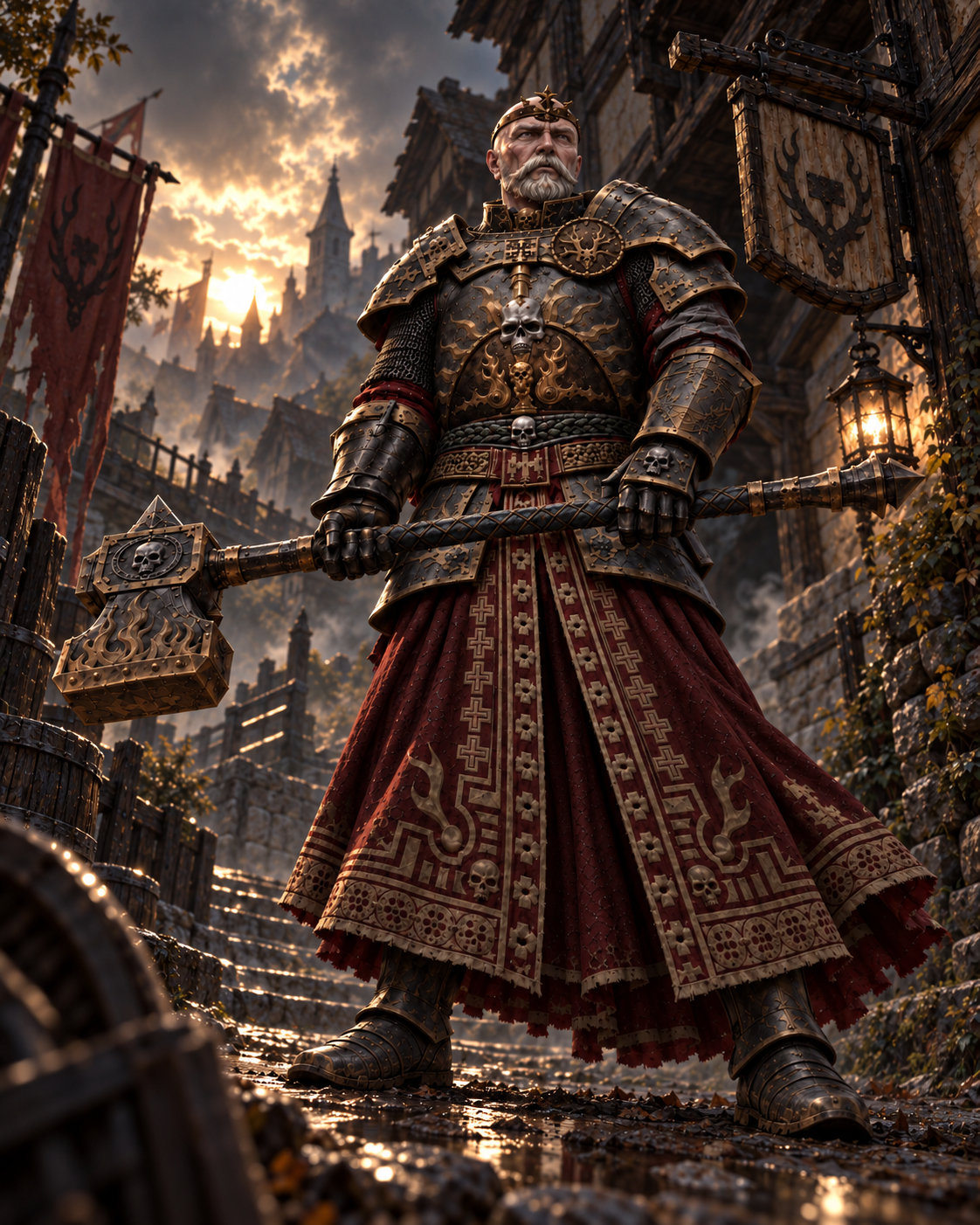
Overview
Cairden Mueller is an itinerant Warrior Priest of Sigmar belonging to the Order of the Silver Hammer. A soldier before he became a priest, he brings military experience and severe personal discipline to a vocation that joins pastoral duty with the defense of the faithful. He is already serving the Sigmarite community of Grimmenhagen when the Chaos attack draws him into its defense.
Personality
Cairden is austere and mission-driven, regarding religious duty with utmost seriousness. His concern for those entrusted to him is sincere, but his compassion operates within firm doctrinal and moral obligations. He can offer mercy without setting aside judgment, and treats the protection of the faithful as a responsibility to be carried out with discipline.
His faith is more than a response to loss. It developed while he was a soldier, under the influence of his younger brother Johren, and remains the foundation of his priesthood.
History
Stirland and Military Service
The Mueller family belongs to the Stirlander cultural milieu. Its hereditary surname derives from ordinary Reikspiel usage associated with milling. Cairden’s parents, still relatively young when he was born, chose an older regional given name that expressed their attachment to Stirland’s inherited traditions. By Johren’s birth, their desire to emphasize that distinctiveness had softened, and they chose a more conventionally Imperial name.
Cairden initially sought military service rather than the clergy. He began in the local militia and was content with a soldier’s life. Johren entered religious life enthusiastically and gradually brought his elder brother toward deeper personal devotion to Sigmar. Cairden became a serious believer while continuing to serve as a soldier.
Johren’s Death and the Priesthood
Johren became a priest of the Order of the Torch, tending the modest Sigmarite congregation of Wördern. His ministry also made him the spiritual father and intellectual mentor of the young Elias Redyn.
Local heretics murdered Johren while Elias was still a teenager. The death radicalized Cairden’s existing devotion and redirected his military experience toward the militant priesthood. He entered the Order of the Silver Hammer, carrying a soldier’s abilities into a religious vocation grounded in the faith his brother had helped cultivate.
Grimmenhagen
Cairden’s later ministry took him through the Empire. He reached Grimmenhagen several weeks before the immediate military crisis and remained when he found its Sigmarite community inadequately served by dedicated pastoral leadership. He originally intended the stay to be temporary.
The Chaos attack brought his religious and martial duties together. As the defense developed, he voluntarily attached himself to the Order of the Griffon’s operations. He cooperates with battlefield officers while retaining his wider priestly responsibilities and the freedom to withdraw from that service.
Relationships
Cairden and Elias are connected through Johren’s life and death. One knew him as a younger brother, the other as a mentor and protector. They became acquainted before their separate wanderings, sharing a religious foundation and a profound bereavement, though Cairden is considerably older.
Their vocations remain distinct. Cairden is a militant priest with pastoral duties; Elias investigates and judges heresy as a Templar. Common convictions make professional cooperation natural without requiring them to agree in every matter of doctrine or procedure.
Affiliations
Notes
Unresolved details
- His family’s exact hometown; Kelham remains a candidate.
- His age, earlier military assignments, and the circumstances of Johren’s murder.
- The degree of his familiarity with Elias after Johren’s death.
Grimmenhagen’s lack of adequate dedicated Sigmarite leadership is an approved local-history decision. It does not imply the absence of other clergy or religious traditions.