Character preview image
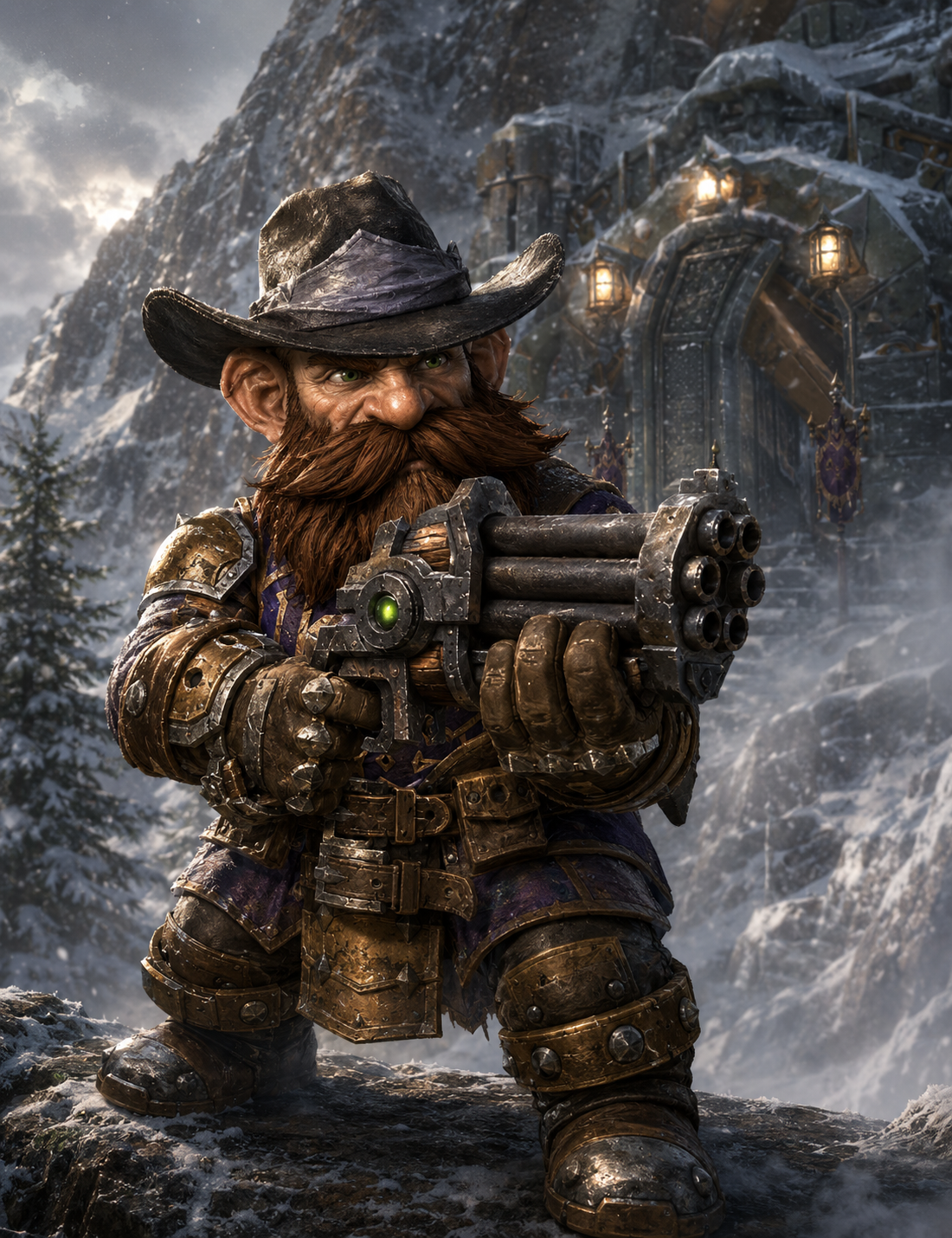
Corvo Cogblast
Character Sheet
Identity
- Full Name: Corvo Cogblast
- Short Name: Corvo
- Family Name: Cogblast
Appearance
- Gender: Male
- Apparent Age: Older adult
- Height: Short
- Build: Rugged
- Eyes: Blue
- Skin: Fair
- Facial Hair: Brown mustache
Overview
Corvo Cogblast is a veteran gnomish hunter, engineer, peace officer, and military aviator. He founded the Gnomeregan R.A.N.G.E.R.S. Corps, the small corps of remote-area officers from which G.E.A.R. later developed. Corvo has the bearing of an old frontier lawman: rugged, self-contained, practical, and entirely at ease when working beyond immediate support. Compared with many gnomes, he speaks sparingly. When he does speak, it is usually because he has already decided what matters.
His fieldcraft is distinctly gnomish. Corvo is a marksman, tracker, investigator, navigator, and engineer, but not principally a naturalist or animal handler. The companions that travel with him are mechanical constructs, often hound-like machines built to scout, track, guard, carry out field tasks, and fight at his side. His rifle, traps, engineered ammunition, explosives, tools, and machines serve the practical functions that another hunter might accomplish through a trained beast and wilderness lore.
Corvo believes that a competent officer far from support must be trusted to understand an objective and solve the problem before him. He respects command, but he does not confuse an order’s prescribed method with its purpose. This principle first made him difficult for his Second War commanders to manage; it later became the foundation of the corps’ doctrine.
Gnomeregan Peace Officer
Before the Second War, Corvo served as a peace officer within Gnomeregan and its surrounding tunnels, works, and industrial infrastructure. His work combined investigation and ordinary policing with the hazards of a vast underground city: mechanical failures, dangerous machinery, cave and tunnel environments, emergency response, and the defense of gnomish citizens and property. It gave him a disciplined foundation in marksmanship, engineering, evidence, and independent judgment, but it remained work conducted inside Gnomeregan’s own civilization and its established support systems.
The Second War
The Horde’s invasion of Khaz Modan forced Corvo into a wider war. As a captain in Gnomeregan’s defense, he helped turn the terrain around the city into a hostile, engineered obstacle for the invaders. The fighting was his first sustained experience of surface warfare and of enemies far more dangerous than the threats of an underground peace officer’s usual beat.
Corvo became one of Gnomeregan’s most capable flying-machine pilots. The craft of his era were reconnaissance machines, but he steadily expanded what one could accomplish. He dropped bombs and charges, improvised release mechanisms, used grenades, incendiaries, and smoke from the air, and fired his own rifle whenever the flight allowed it. He developed a taste for low, dangerous passes and for field modifications that could turn a reconnaissance opportunity into an attack, sabotage, or rescue without compromising the mission’s actual purpose.
That distinction mattered. Corvo was never casually insubordinate, but he judged orders by the problem they were meant to solve. A prohibition on engagement intended to preserve secrecy did not prevent him from acting if he could damage the enemy without exposing what needed protecting. His commanders were repeatedly exasperated, then repeatedly vindicated by the results. Over time they learned to give him the objective, the reason it mattered, and the constraints that truly could not be violated, then leave the method to him.
Repeated crashes and forced landings made Corvo more than an aviator. Shot down in wilderness and hostile territory, sometimes behind enemy lines, he learned to navigate, evade patrols, repair or destroy wreckage, ration supplies, establish alarms and traps, signal friendly forces, and survive alone until he could return. His engineering and investigative habits made the wild another system to read and solve. When the Alliance assault under Anduin Lothar and Turalyon broke the Horde’s position around Khaz Modan, Corvo fought in the gnomish push outward from the city. He then continued in the wider Alliance war as a reconnaissance pilot, carrying his new understanding of remote and unsupported work across the Eastern Kingdoms.
The R.A.N.G.E.R.S. Corps
After the war, Corvo returned to a Gnomeregan increasingly connected to a larger world. Engineers, pilots, merchants, researchers, couriers, and expeditions were beginning to travel beyond the city’s familiar networks. In a distant emergency, one gnome might be needed to investigate a crime, repair a machine, guide an expedition, protect civilians, negotiate with another authority, and decide what to do before a specialized team could arrive.
Corvo’s answer was the Gnomeregan Remote Area Navigation, General Enforcement, Response & Support Corps. The corps commissioned gnomish generalists for remote operations concerning gnomish people, technology, interests, responsibilities, expeditions, and emergencies. Its rangers were expected to understand their mandate, use judgment, and begin solving a problem rather than wait helplessly for every necessary specialist.
The corps remained deliberately small. Most rangers were reservists with ordinary careers as engineers, pilots, surveyors, peace officers, or other specialists, yet their commissions were complete commissions rather than a lesser form of membership. A tiny active cadre ranged widely, often working alone for weeks or months. Corvo stayed among those field officers instead of retreating into administration. The corps’ office-based adjutant, Itsi Toggletorque, kept its records, supplies, communications, reserve activations, and authority intact from Gnomeregan. Corvo treated that work as expertise equal to his own in the field, even when Itsi was understandably exasperated by the people she had been charged with organizing.
The Fall of Gnomeregan
The trogg invasion during the Third War drew the corps back into the defense of its own city. Reserve rangers were activated, and the active cadre fought through fractured tunnels, damaged works, isolated civilians, and failing lines. Corvo’s experience made him one of the senior field commanders during the catastrophe.
The original corps did not survive it. An emergency blast door sealed between Corvo and the rest of his command as the city fell to radiation and chaos. He was physically unable to reach them; every other ranger died beyond the barrier. Itsi, still directing communications, evacuation, and recovery from a central coordination post, was the only other survivor of the corps’ institutional structure. Corvo reached her only in time to get her out of Gnomeregan, not in time to spare her severe irradiation. She survived as a leper gnome until later treatment or stabilization became possible.
For years afterward, the corps was not a functioning institution. Gnomeregan’s people had become refugees, and preserving a continent-ranging specialist service could not take priority over survival. Corvo nonetheless continued its work in practice: scouting dangerous routes, recovering technology, searching for survivors, investigating threats, supporting displaced gnomes, and working around the lost city with dwarven and Alliance authorities. The ranger identity survived through him and Itsi’s records until Gnomeregan’s institutions could again support specialized field units.
G.E.A.R.
The rebuilt corps was not simply a memorial to the dead. Its rangers retained their breadth, technical skill, discretion, and independence while evolving beside organizations such as Gnomeregan Covert Ops. By the Fourth War, their tradition had become the more heavily militarized and aviation-focused Gnomish Elite Aerial Rangers, or G.E.A.R.
G.E.A.R. inherits the corps’ expectation that an officer can reconnoiter, improvise, use engineering, exploit mobility, and act effectively without constant direction. Its focus is narrower and more military than the original corps, but its operating culture owes much to Corvo’s wartime experience and institutional design.
Corvo serves in G.E.A.R.’s senior command structure, where his experience and the corps’ legacy carry real operational weight. He remains capable of taking the field as a hunter, pilot, and engineer. Tavin “Tinks” Brasslock, however, is G.E.A.R.’s commander and directs its routine readiness, personnel, deployments, and mission execution. Their relationship is professional and institutional; they are not related.
Relationships
- Tinks - commander of G.E.A.R.; their professional relationship joins Tinks’s active command with Corvo’s longer institutional and field experience.
- Itsi Toggletorque - corps adjutant and one of the two surviving figures of the original corps; Corvo respects her administrative authority and protects her in field danger.
Affiliations
- Alliance - current
- Gnomeregan - homeland; former peace officer and defender
- Gnomeregan R.A.N.G.E.R.S. Corps - founder and active field officer during its original era; later rebuilder
- G.E.A.R. - senior command
Timeline
- Before the Second War - served as a Gnomeregan peace officer.
- Second War - defended Gnomeregan and Khaz Modan as a gnomish captain and flying-machine pilot; developed the remote fieldcraft that shaped his later doctrine.
- After the Second War - founded the Gnomeregan R.A.N.G.E.R.S. Corps.
- Third War - helped lead Gnomeregan’s defense during the trogg invasion; survived the destruction of the original corps and rescued its irradiated adjutant, Itsi Toggletorque.
- After the fall of Gnomeregan - preserved and gradually rebuilt the ranger tradition while serving displaced gnomish interests.
- Fourth War - joined G.E.A.R.’s senior command structure as the successor organization took form under Tinks’s command.
Hooks
- The exact composition and individual histories of the original corps remain open.